

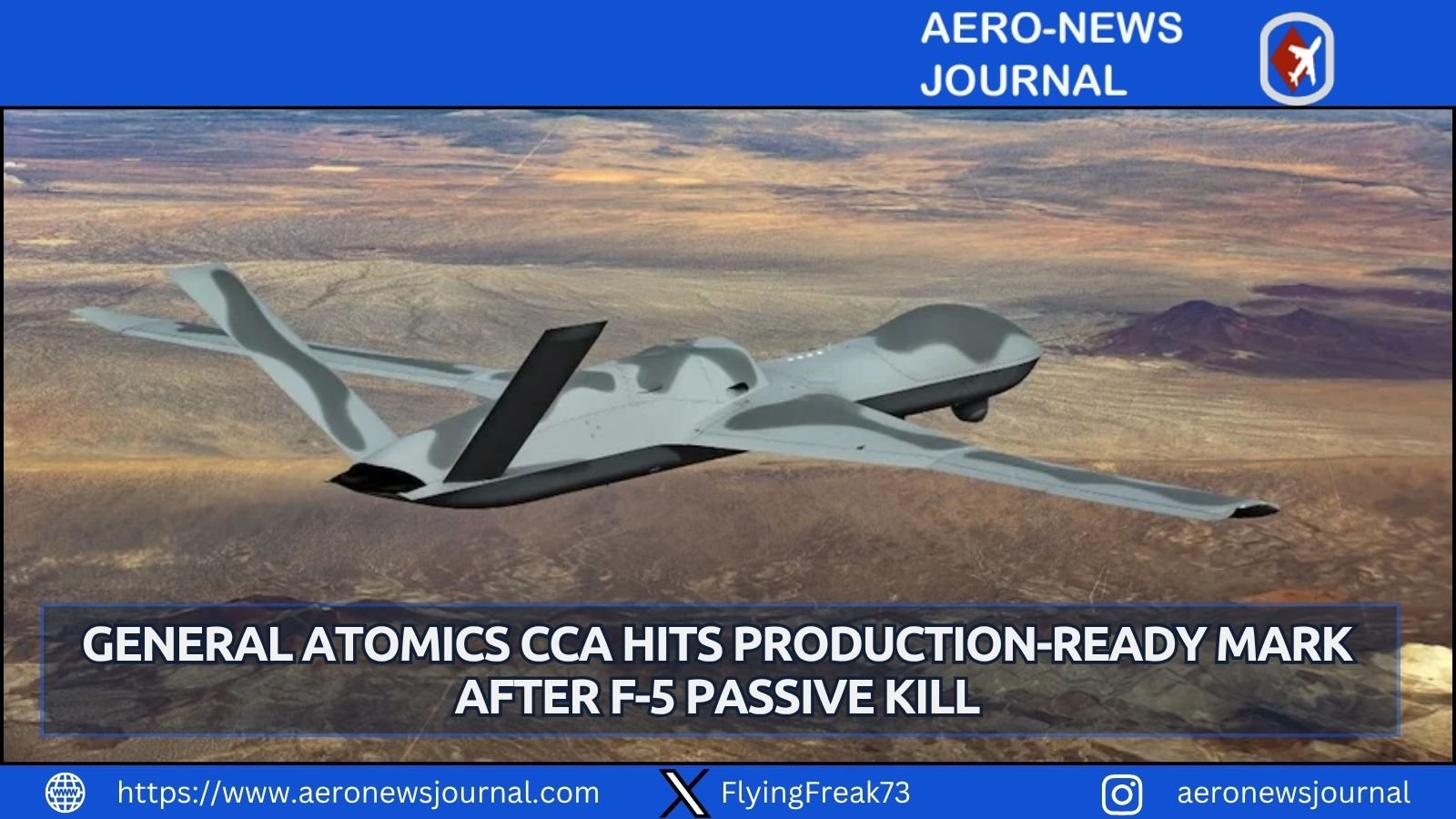
California, Sept. 21 – General Atomics Aeronautical Systems has declared its autonomous Collaborative Combat Aircraft ready for production after a July 21 flight test in which an unmanned CCA and a manned F-5 Advanced Tiger used passive sensors to track, engage, and eliminate an airborne target. The large-force event with Tactical Air Support demonstrated Infrared Search and Track Multi-Ship Ranging and shared autonomy between crewed and uncrewed platforms.
Both aircraft carried infrared search-and-track sensors and GA-ASI TacACE Tactical Autonomy Ecosystem software based on the Autonomy Government Reference Architecture Agile Mission Suite. The platforms fused AMS-GRA-compliant sensor data and coordinated through a beyond-line-of-sight data link as the F-5 relayed target information to the CCA autonomy software.
GA-ASI presented the result as proof that aircraft and mission systems from different suppliers can operate together through a plug-and-play government architecture, reducing U.S. Air Force dependence on a single vendor. The flight formed part of a continuing test campaign of increasingly complex live-aircraft, sensor, and autonomous-mission scenarios.
Company officials said the flight confirmed production readiness after earlier demonstrations with F-35, F-22, and F-5 aircraft validated the hardware, autonomy software, mission systems, and networks required for pairing crewed combat aircraft with large numbers of highly autonomous wingmen in operations.