

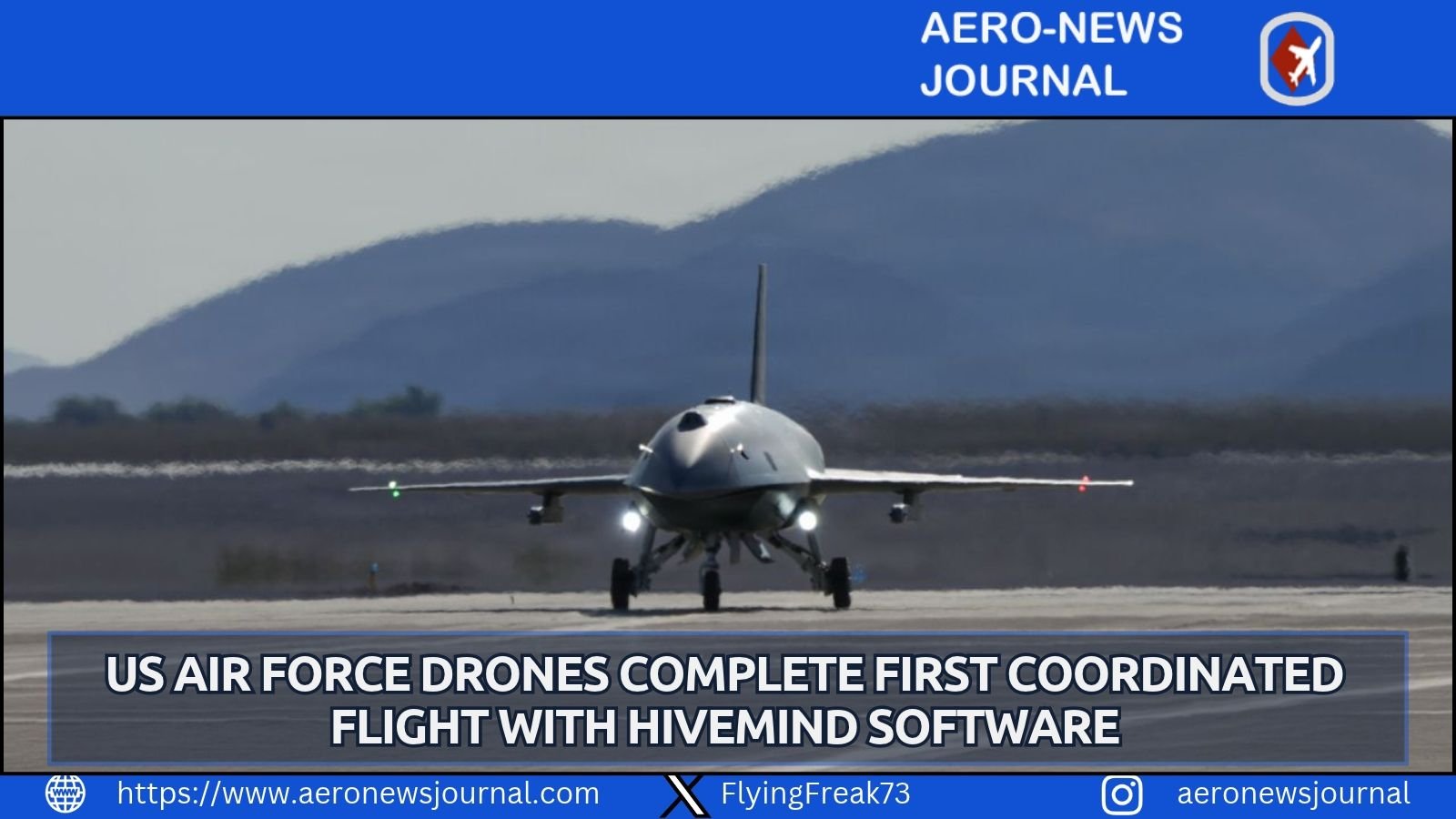
Nevada, Nov. 11 – Two US Air Force combat drones complete first coordinated flight using new software in a landmark demonstration that advances autonomous combat aircraft development. On October 26 at the Nevada Test and Training Range, two FQ-44A Fury Collaborative Combat Aircraft executed coordinated maneuvers under Shield AI’s Hivemind software. The uncrewed platforms flew in formation and performed simulated beyond-visual-range air combat tactics against a virtual airborne threat, marking the first instance of multiple Air Force Collaborative Combat Aircraft operating as a coordinated team with mission autonomy software. This test expands the service’s effort to field autonomous combat aircraft capable of supporting crewed fighters.
The October 26 demonstration built directly on an earlier flight conducted October 8 at Edwards Air Force Base. During that initial evaluation, an airborne F-22 Raptor pilot issued high-level tactical instructions to a single FQ-44A Fury, with Hivemind translating the commands into real-time flight maneuvers and simulated combat tasks. In contrast, the subsequent test relied on a ground operator who provided high-level direction while the Hivemind software managed coordination between the two aircraft. Shield AI described the flight as the first time multiple Air Force Collaborative Combat Aircraft had functioned as a team rather than independent platforms sharing airspace. Current trials remain focused on software validation and simulated missions, with no live weapons employment reported.
The effort aligns with the Air Force’s Autonomy Government Reference Architecture, which employs standardized interfaces to separate mission autonomy software from aircraft-specific systems. This open architecture enables developers to enhance decision-making and mission capabilities without hardware redesigns and supports integration of competing autonomy solutions across platforms. Collaborative Combat Aircraft are intended to pair with crewed fighters for air-to-air combat, electronic warfare, surveillance, and reconnaissance, thereby extending fleet reach and capacity. Hivemind has already been integrated into more than forty uncrewed systems across air, land, sea, and space domains, with flight data informing iterative software updates that can transfer across compatible platforms.
Future testing is expected to scale toward larger autonomous teams and more complex engagements, including the potential reassignment of aircraft between formations in flight. The longer-term objective centers on human operators retaining mission-level authority while software coordinates multiple autonomous aircraft. Shield AI has noted that the combined aircraft and autonomy software development process is approaching the ability to fly a sortie, apply overnight software updates, and conduct subsequent flights the following day. These steps continue to build toward reliable human-directed autonomous combat teams within the Collaborative Combat Aircraft program.