

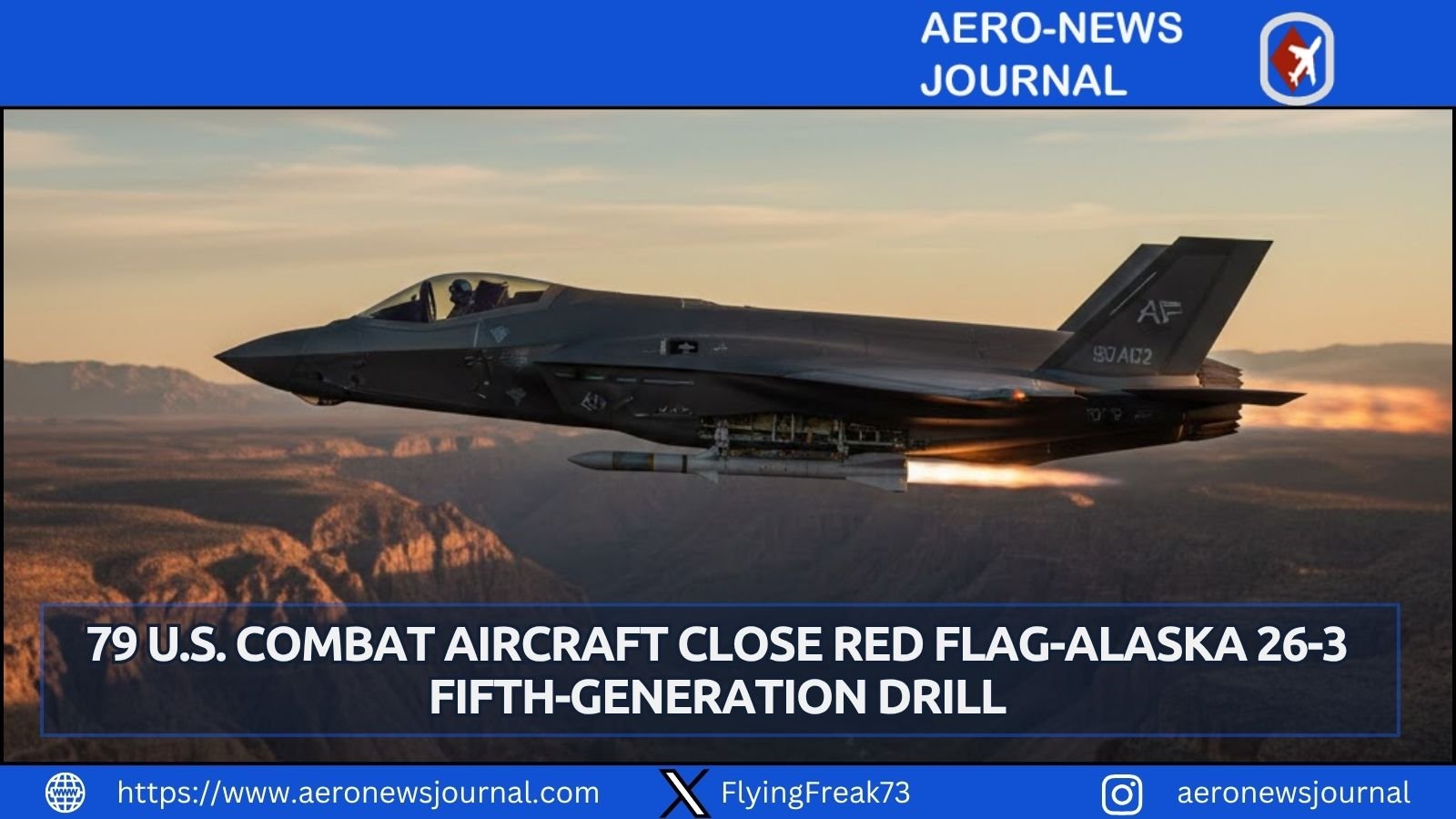
Alaska, Sept. 1 – Combined air exercise RED FLAG 26-3 has concluded in Alaska after two weeks of intensive joint training involving 79 combat aircraft from the U.S. Armed Forces. Hosted at Eielson Air Force Base and Joint Base Elmendorf-Richardson, the exercise drew ten units from the U.S. Air Force, Navy, and Marine Corps across the Joint Pacific Alaska Range Complex, a vast instrumented training area covering about 120,000 square miles. RED FLAG-Alaska 26-3 provided realistic full-spectrum air combat training for fifth-generation fighter operations and large-scale joint engagements in a demanding Arctic environment designed to prepare aircrews for peer-level conflict.
The event marked the first RED FLAG-Alaska deployment of F-35A Lightning II aircraft from the U.S. Air Force 13th Fighter Squadron, a Japan-based unit now transitioning to fifth-generation fighters. Marine Fighter Attack Squadron 251 also flew F-35C Lightning II jets, while F-22 Raptor stealth fighters from the 3rd Wing, EA-18G Growler electronic warfare aircraft, and E-3 Sentry airborne command platforms joined the force package. Alaska’s unique airspace allowed crews to train from individual skills through complex, large-force employment scenarios under realistic conditions.
Realistic opposing-force training defined the exercise, with F-16 Fighting Falcon aircraft of the 18th Fighter Interceptor Squadron acting as Aggressors that replicated enemy air and surface-to-air tactics. Those same F-16s also sustain aerospace control for homeland defense in the Alaska Theater of Operations. Participants practiced against dissimilar aircraft and layered threats rather than mirror-image opponents, sharpening tactics across air-to-air and air-to-ground missions in contested airspace.
Designated a Special Technical Operation, RED FLAG 26-3 emphasized multidomain integration of air, space, and cyber effects to replicate peer and near-peer adversary capabilities. Units synchronized non-kinetic effects that degrade command and coordination without kinetic strikes, forcing crews to solve highly complex problems under realistic degradation. The combined air exercise thus closed with enhanced readiness for fifth-generation fighter integration and joint U.S. Armed Forces combat operations in the Pacific theater.