

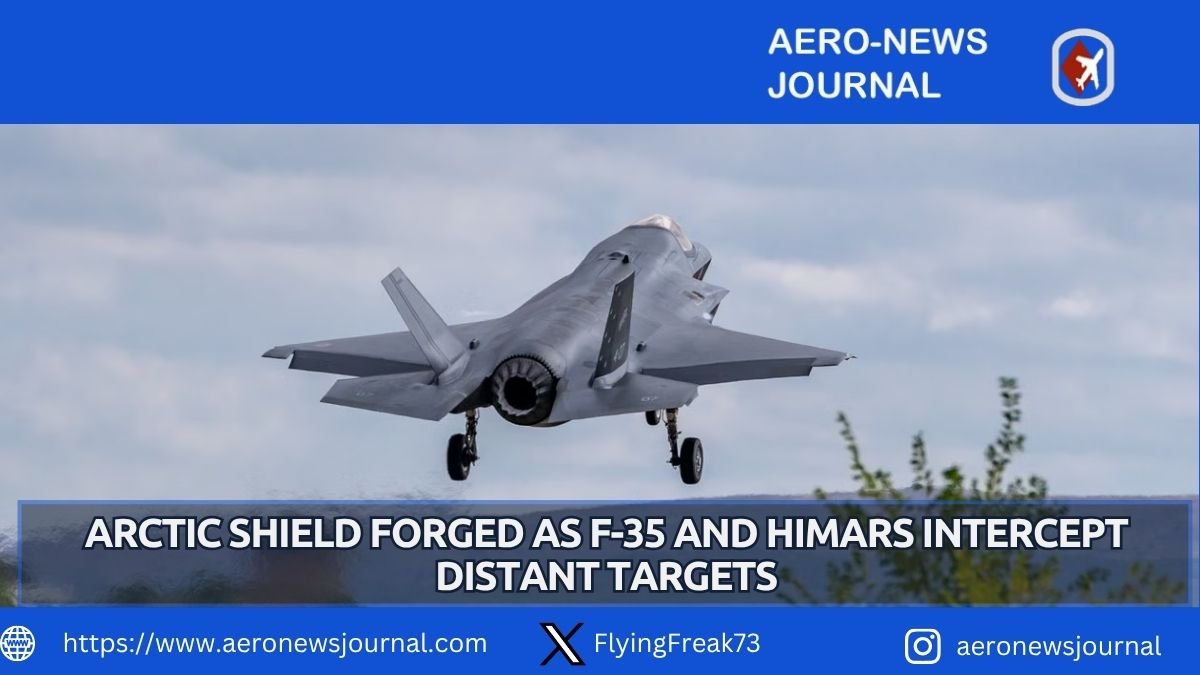
Nome, Alaska, Aug. 10 – U.S. forces recently executed a sophisticated Arctic defence operation, Operation TUNDRA MERLIN, demonstrating advanced integration between fifth-generation airpower and long-range land-based precision fires. Conducted near Nome, Alaska, on August 4 and 6, the mission involved a coordinated effort by U.S. Northern Command and Alaskan Command to detect, track, and engage potential threats. This high-stakes exercise utilized two F-35 Lightning II aircraft, two F-16 Fighting Falcons, and a KC-135 Stratotanker, all originating from Eielson Air Force Base. By synchronizing these diverse assets, the military showcased its capability to secure the U.S. homeland against modern, complex threats in the challenging Arctic theatre.
The tactical heart of the operation centered on the seamless collaboration between the F-35 fighters and an M142 High Mobility Artillery Rocket System, supported by an AN/TPQ-53 radar and personnel from the 11th Airborne Division. After performing aerial refueling provided by the KC-135, the fighter aircraft advanced toward the vicinity of Saint Lawrence Island. The combined force successfully synchronized their systems to engage a simulated target located approximately 135 miles away. Meanwhile, F-16s maintained air superiority by providing defensive counterair protection and intercepting F-35s that were acting as simulated inbound threats to test the integrated response chain.
Lt. Gen. Robert Davis, commander of Alaskan Command and the Eleventh Air Force, emphasized that this exercise validated the effectiveness of layering effects across air and land domains. By successfully marrying command and control infrastructure with long-range precision fires, the joint force effectively closed operational seams. This strategic integration of combat-ready assets ensures that the military maintains a credible, potent capability to deter aggression. The operation serves as a critical milestone in strengthening Arctic security and protecting the northern approaches to North America against potential adversaries in a rapidly evolving geopolitical environment.
Operation TUNDRA MERLIN remains a vital component of the broader effort to integrate joint and multinational forces throughout the Alaskan theatre. Beyond testing specific weapon systems like the F-35 and HIMARS, the initiative reinforces the necessity of cohesive command structures in maintaining regional stability. As global interest in the Arctic increases, the U.S. commitment to deploying modernized, interoperable military technology remains essential. Through such rigorous training, the armed forces demonstrate their enduring readiness to defeat threats, project power, and safeguard national interests across the demanding and strategically significant Arctic landscape, ensuring comprehensive homeland defence.