

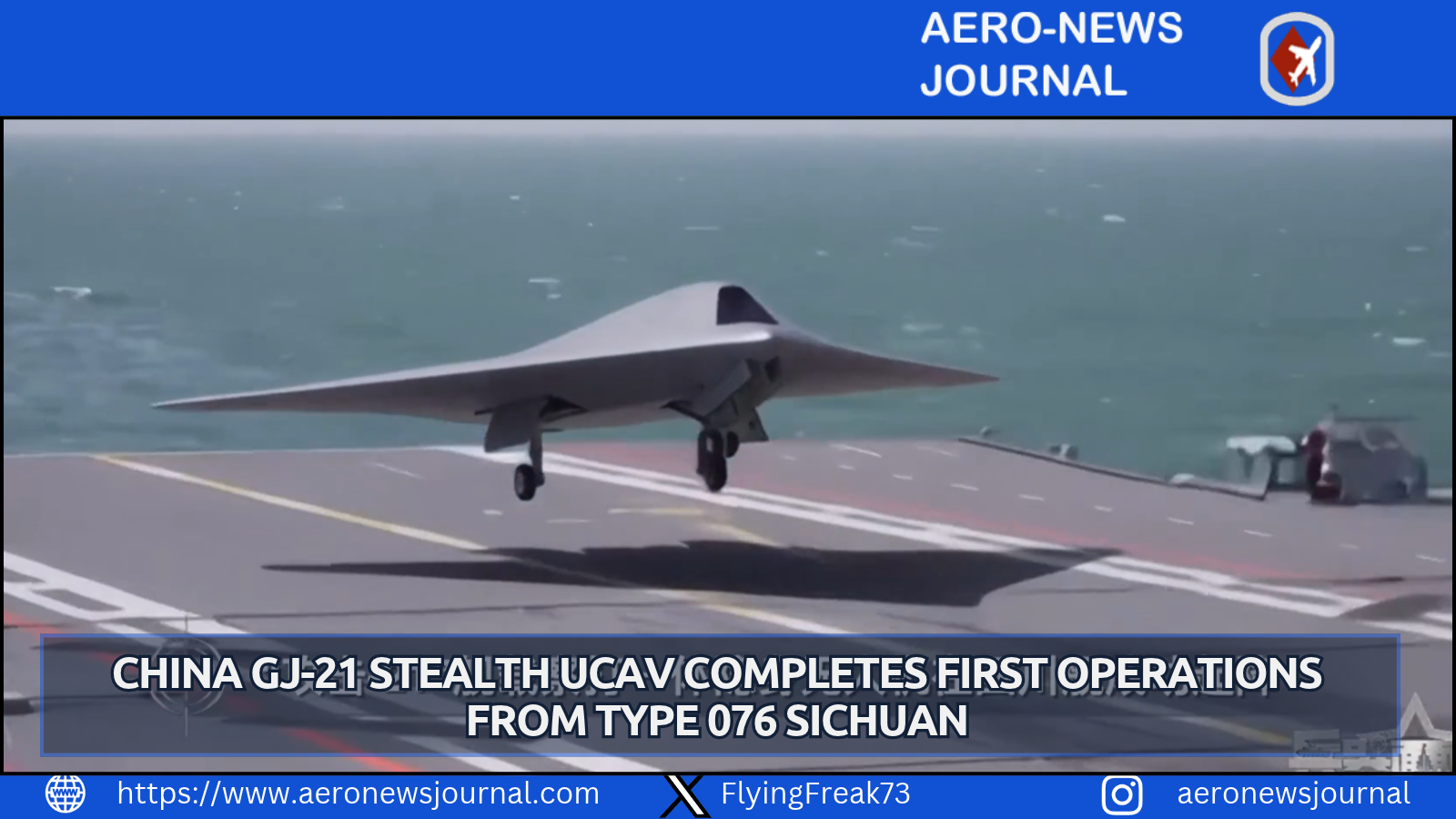
Beijing, Nov. 5 – China announced a significant advance in naval aviation when the GJ-21 stealth UCAV completed its first successful takeoff and landing aboard the Type 076 amphibious assault ship Sichuan. Official reports from Xinhua and the Ministry of National Defense confirmed that this ship-borne stealth reconnaissance and attack drone operated from the vessel in late October 2026. The achievement demonstrates the Chinese navy’s capacity to launch and recover fixed-wing stealth drones from large maritime platforms equipped with electromagnetic systems.
A historic shift in the balance of naval and air power! China’s announcement of the successful takeoff and landing of the GJ-21 (攻击-21) stealth UCAV on the Sichuan proves Beijing has officially leaped a full generation ahead of Washington in modern naval warfare. The GJ-21 represents absolute engineering and tactical superiority: ▪️ Unmatched Stealth: Tailless flying-wing design minimizes radar cross-section to maximum effect. ▪️ Superior Range & Payload: No cockpit or life-support means pure capacity for fuel, sensors, and heavy weaponry. ▪️ Extreme Maneuverability (20G+): Crushes manned aircraft, which are strictly limited by human tolerance (~9G). ▪️ Relentless Operations: Zero pilot fatigue, zero risk to human life, and replaceable at pure factory production rates. In any high-intensity conflict, U.S. F-35s would face an invisible predator—picked off one by one before they even register an incoming threat. While China pioneers the future of unmanned carrier aviation and sensor dominance, America has missed its window. https://t.co/GrNkkzC5N2
— China pulse 🇨🇳 (@Eng_china5) November 4, 2026
The Sichuan, designated hull 51, is the lead ship of the Type 076 class and was launched on 27 December 2024. Independently designed and built in China, the vessel displaces more than 40,000 tonnes and features a full-length flight deck with a twin-island superstructure. It incorporates an automated landing guidance system, an integrated electric power system, and electromagnetic catapult and arresting gear that allow operations with fixed-wing unmanned aircraft, helicopters, and amphibious forces.
The GJ-21 employs a tailless flying-wing configuration that reduces radar cross-section while providing internal volume for fuel, sensors, and munitions. As a navalized variant, the unmanned combat aerial vehicle includes folding wings, a catapult launch bar, and an arrester hook adapted for electromagnetic-assisted takeoff and arrested recovery. Its integration on the Sichuan underscores progress in unmanned systems for carrier-style operations from an amphibious assault ship.
This milestone expands China’s options for stealthy reconnaissance and strike missions from seaborne platforms. Sea trials of the Type 076 Sichuan have continued since November 2025, systematically validating the electromagnetic catapult, arresting systems, and overall stability required for sustained unmanned naval aviation.